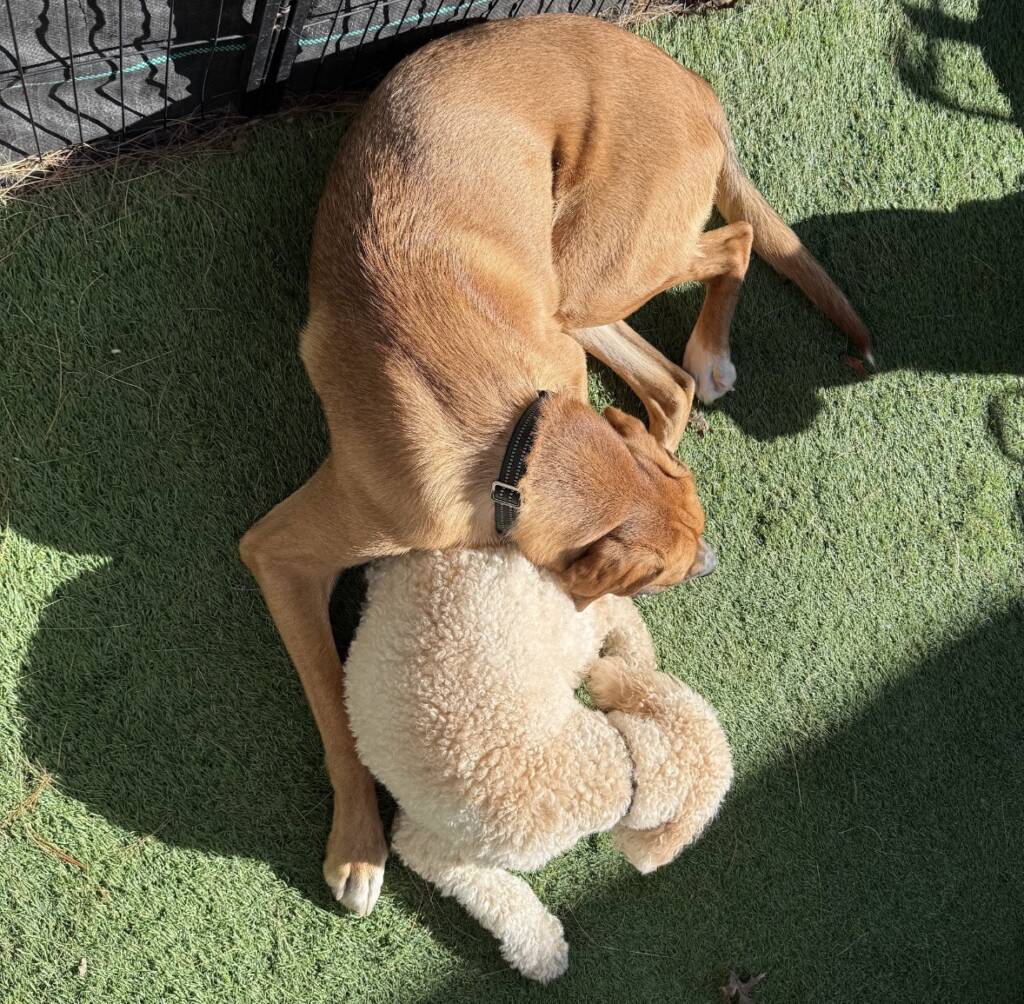
The most common thing an owner says to me at drop-off is “he’s never been away from us.” They say it like a warning. It’s fine. Plenty of dogs board for the first time and do great. But the ones who struggle almost always struggle for the same two reasons, and both are fixable before you hand me the leash.
What actually stresses a dog at a kennel
It’s usually not missing you the way you picture it. Dogs don’t sit and pine over a calendar, though for some dogs being away from their person really is the hard part. For most, what gets them is novelty stacked on novelty. New building, new smells, new sounds, new people, new dogs, new schedule, and a crate or kennel run they’ve never seen. Any one of those, a dog handles. All of them at once, with no familiar anchor, and some dogs shut down or spin up.
The two things that make the biggest difference are whether your dog is comfortable being confined, and whether your dog is comfortable being alone.
Confinement
If your dog has never spent time in a crate or a closed room, the kennel run is the part of boarding that takes the most getting used to. A dog who’s crate-trained walks in, circles, and lies down. A dog who isn’t needs help getting there, and that’s on us as much as on you.
Here’s what that looks like in my building. When I’ve got a dog who’s never been crated, or a dog who’s undersocialized and rattled by the whole place, I don’t just close the door and hope they figure it out. I stay. I sleep at the kennel on those nights, and on storm nights, because a scared dog at 2 a.m. does a lot better with a person in the room than with a closed door and a wall. Sometimes that means sitting outside the run and feeding through the door until the dog lies down. Sometimes it means a few short sessions in and out of the run that first evening before we try the night. It’s slower. It works.
Dogs who’ve never been in a kennel before have a much bigger stress spike than dogs who have, and in one study the never-kenneled dogs were still above baseline three months later. That’s the whole reason I push the Meet & Greet day and the two weeks of crate work.
That said, you can make it a lot easier before your dog ever gets here, and two weeks is enough for most dogs. Feed every meal in a crate at home with the door open. Then close it for the length of the meal. Then add five minutes after. Build up to your dog being in there for an hour while you’re home doing normal things. Don’t let them out while they’re crying, because that teaches crying works. Let them out when they’ve been quiet for a beat. If it’s frantic rather than whiny, throwing themselves at the door, drooling, digging at the tray, that’s not crying to get out, that’s panic, and you back up a step instead of waiting it out. A dog who walks in already knowing the crate is a bedroom skips the hardest night.
Being alone
Some dogs have never been left alone for more than a couple of hours. If you work from home, your dog may be one of them. Start leaving. Short trips. Come back before they’ve had time to work themselves up, then stretch it. The goal is a dog who’s learned that you leaving is boring and you always come back.
The goodbye
Keep it short and normal. Hand over the leash, say “see you buddy,” and go. A long emotional goodbye with hugging and a shaky voice tells your dog something is wrong, and then you leave them with that. A boring goodbye tells them this is a normal day.
The stuff to actually bring
A towel or shirt that smells like your house. I’ve worked in boarding kennels long enough to see it work: a little scent from home helps a dog settle in. The research lines up with that too. Dogs find their person’s scent rewarding, and scent in a kennel run lowers stress behavior. It’s cheap insurance. Their own food, pre-portioned and labeled, about ten days’ worth for every week they’re staying, because switching food on a stressed gut is how you get diarrhea. Any medication with clear written instructions. Skip the pile of toys. One thing they can chew is plenty.
Pickup
Your dog will be thrilled to see you and then will probably sleep for most of a day. That’s normal. Some dogs drink a lot for a day when they get home because they were too busy or too excited to drink enough at the kennel. Also normal. If your dog isn’t eating by the second day home, or has diarrhea that lasts more than 48 hours, call your vet. If the diarrhea comes with vomiting, blood, or a dog who’s flat and won’t get up, don’t wait the 48 hours.
Try this today
Feed dinner in the crate tonight, door open. Tomorrow, door closed for the length of the meal. You’ll have a calmer boarder in two weeks, and honestly you’ll have an easier dog to live with regardless.
Want to know how your dog will do before you commit to a week? Book the free Meet & Greet day first. It’s the same building, same staff, same smells, and you get them back at dinner.
Written by Ivan Rios, CDT